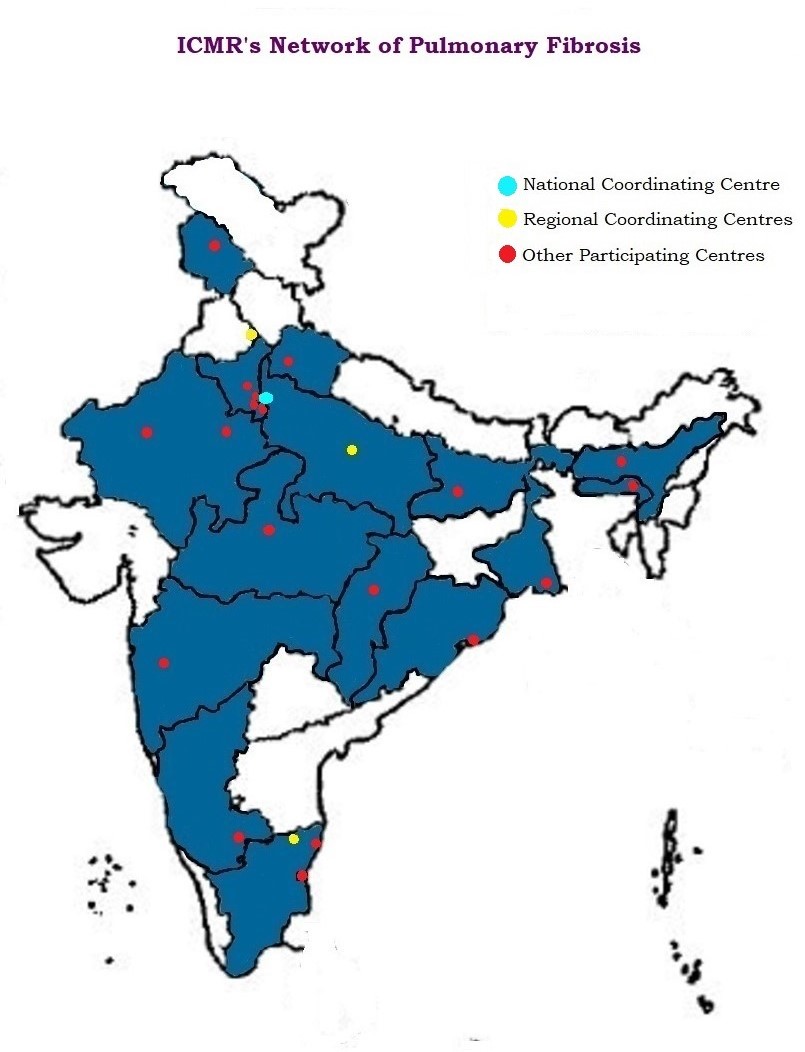
ICMR's Network of Pulmonary Fibrosis (INPF)
Pulmonary fibrosis is a serious lung condition caused by myriads of disorders which predominantly affect the lung parenchyma. Pulmonary fibrosis is irreversible and, in many cases, it is progressive culminating into respiratory failure and untimely death. The etiology of pulmonary fibrosis may be known (infections, drugs, exposure to radiation or antigen, various connective diseases) or in many cases the etiology remains obscure. Interestingly, despite being heterogenous in origin, these disorders have a similar clinical presentation – shortness of breath and reduced lung volumes on spirometry; hence, these diseases are known by a common name “Interstitial Lung Diseases (ILDs)”. The prevalence of ILDs in India is not known; however, prevalence (per 10,000 persons) of ILD in the Europe and the USA was reported as 0.63–7.6 and 7.43, respectively.
ILDs, associated with pulmonary fibrosis, encompass more than 200 entities of acute and chronic diffuse lung diseases of known and unknown etiology. ILDs of unknown etiology are called as idiopathic interstitial pneumonias (IIPs) and are further classified as – usual interstitial pneumonia (UIP) or idiopathic pulmonary fibrosis (IPF), non-specific interstitial pneumonia (NSIP), cryptogenic organizing pneumonia (COP), acute interstitial pneumonia (AIP), respiratory bronchiolitis-associated interstitial lung disease (RB-ILD), desquamative interstitial pneumonia (DIP) and lymphocytic interstitial pneumonia (LIP). Other common ILDs include sarcoidosis, connective disease associated interstitial lung disease (CTD-ILD) and hypersensitivity pneumonitis. Recently, the COVID pandemic has led to a surge in cases of ILD as a sequelae to COVID-19 pneumonia. It is likely that there will be significant number of patients with post-COVID-ILD.
The diagnosis of ILDs requires a detailed clinical, radiological, with or without lung biopsy data and an intelligent multi-disciplinary team discussion. The treatment is based on the underlying diagnosis. However, broadly, treatment options can be divided as corticosteroids, immunosuppressive and antifibrotics. Lung transplant is the only treatment for patients who have progressive pulmonary fibrosis despite medical management.
In India (similar to rest of the world), the management of ILD among physicians shows significant heterogeneity, leading to considerable delay, inaccurate diagnoses, and potentially inappropriate treatments. These factors ultimately can result in unfavorable outcomes, such as increased morbidity, mortality, and consumption of health resources. Recognizing these issues, the Indian Council of Medical Research (ICMR) took action and established the “ICMR’s Network of Pulmonary Fibrosis (INPF)” in 2021. The main goals of INPF are to investigate the incidence and prevalence of various ILDs and enhance healthcare professionals’ capacity for optimal management of ILDs.